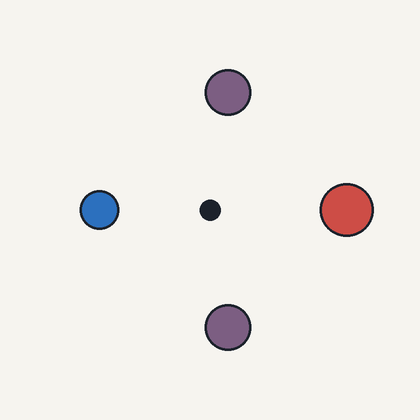
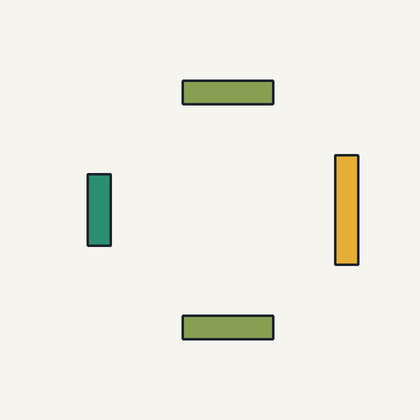
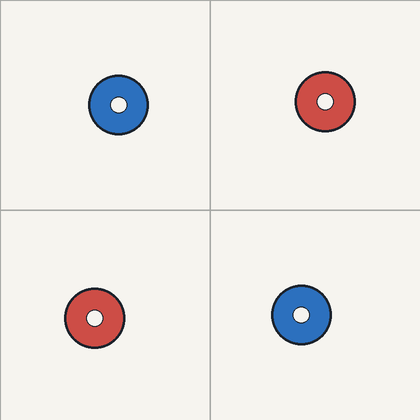
Order-two time glide
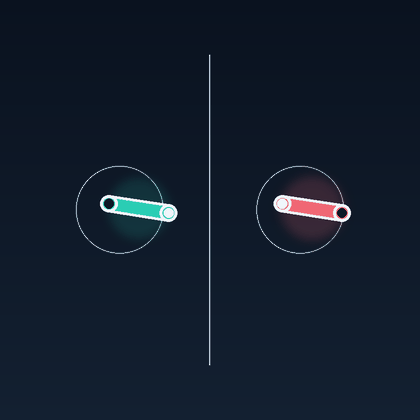
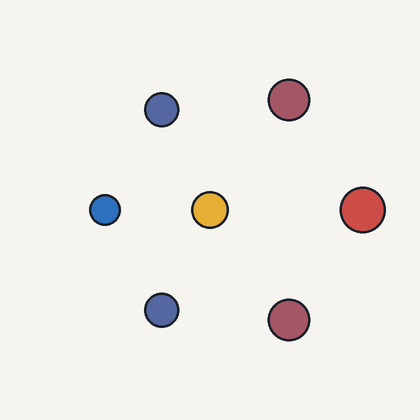
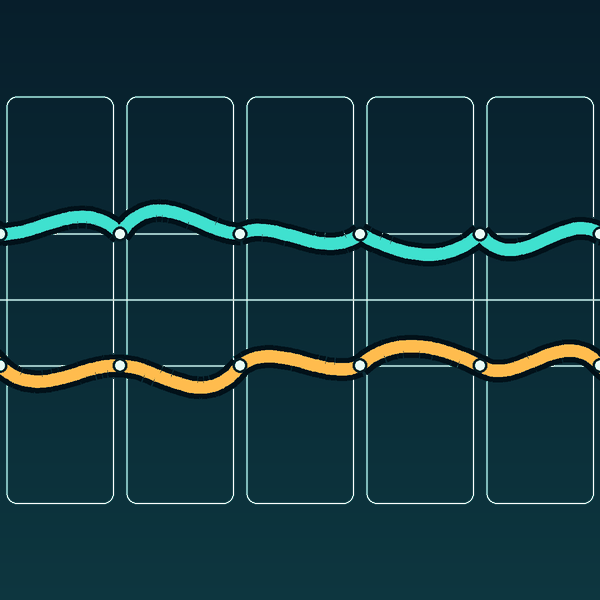
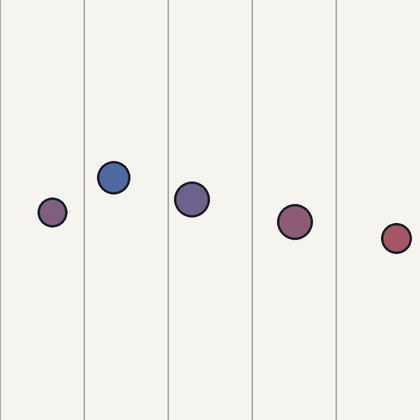
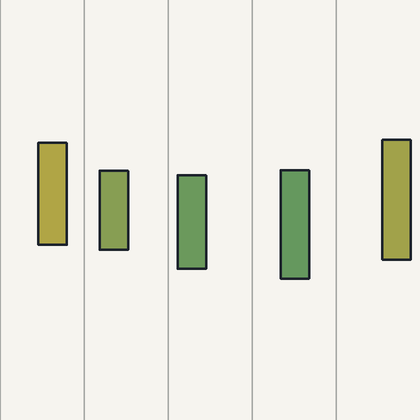
The generator pairs reflection across \(x=0\) with temporal translation by \(T/2\).
Ke–Wu coordinate operation. Time-glide operation; see also Fig. 2.
\(\ST{\mathord{*}1\mathord{\bullet}}{m\mapsto\tau_{1/2}}\)
Exact generator:


Selected periodic realizations · 11 actions · 33 animations
This catalog presents finite periodic renderings of exact equivariant motif models for selected \((2+1)\)-dimensional spacetime-group operations appearing in, or constructions motivated by, the classification of Chenhang Ke and Congjun Wu. Each row realizes one action using three motif families. In every example, the pure temporal translation \(U:(x,t)\mapsto(x,t+T)\) acts trivially on the represented state, so the action descends to periodic time \(S^1_T=\mathbb R/T\mathbb Z\).
A displayed generator has the form \((x,t)\mapsto(g\mathbin{\cdot}x,\pm t+\delta)\). For the non-product examples, the displayed symmetry subgroup is not the direct product of its spatial and temporal projections: the corresponding spatial and phase transformations are not admitted independently. The faithful periodic realizations considered here are therefore a restricted selection from the full classification.
The labels use a proposed phase decoration of Conway orbifold or rosette notation. The spatial prefix specifies the projected spatial action; the double brackets, introduced for this catalog, specify its action on normalized time. The symbol \(\tau_a\) denotes phase translation by \(a\), and \(\iota_b\) denotes phase reversal followed by translation by \(b\). Notation guide and limitations.
Source and scope
In Chenhang Ke and Congjun Wu's paper Two-Dimensional Space-Time Groups: Classification and Applications (arXiv:2604.05619), a general spacetime-group action is written as \((\mathbf r,t)\mapsto(R\mathbf r+\mathbf u,\,st+\tau)\) in Eq. (1). The purpose of the catalog is to make representative spacetime operations from this framework explicit as periodic motif systems. Rows 01, 02, 04, and 05 realize coordinate operations stated in the paper, and row 06 realizes the coordinate action of its listed \(4'\) magnetic point group. Rows 03 and 07–11 are finite-loop specializations or derived constructions using the same screw, glide, reversal, and mixed-translation mechanisms.
The proposed double-bracket notation is not used by Ke and Wu. The \(C_n\) and \(D_n\) designations record displayed quotient or relay orders; they are not identifiers in the paper's 275-group classification. Here graph non-product refers to the graph of a nontrivial phase homomorphism and is distinct from crystallographic nonsymmorphicity. The symbol \(\iota_b\) denotes reversal of the displayed time coordinate, not an antiunitary quantum time-reversal operator.

The generator pairs reflection across \(x=0\) with temporal translation by \(T/2\).
Ke–Wu coordinate operation. Time-glide operation; see also Fig. 2.
\(\ST{\mathord{*}1\mathord{\bullet}}{m\mapsto\tau_{1/2}}\)
Exact generator:


The generator pairs rotation by \(\pi/2\) with temporal translation by \(T/4\).
Ke–Wu coordinate operation. Time-screw operation.
\(\ST{4\mathord{\bullet}}{r\mapsto\tau_{1/4}}\)
Exact generator:


Translation by \(a\) is paired with temporal translation by \(T/3\); neither fractional operation occurs independently in the displayed subgroup.
Project construction. Translation–phase graph based on the spacetime-lattice framework in Fig. 1.
\(\ST{\infty\infty}{a\mapsto\tau_{1/3}}\)
Exact generator:


Reflection across \(x=0\), translation by \(b/2\), and temporal translation by \(T/2\) occur in a single generator.
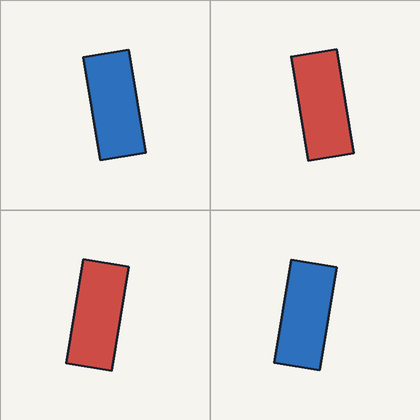
Ke–Wu coordinate operation. Mixed spatial–temporal glide operation.
\(\ST{\times\!\times}{g_{(0,b/2)}\mapsto\tau_{1/2}}\)
Exact generator:


Translation by \(a/2\) is paired with the coordinate reversal \(t\mapsto -t\).
Ke–Wu coordinate operation. Glide time-reversal operation.
\(\ST{\infty\infty}{q_{(a/2,0)}\mapsto\iota_0}\)
Exact generator:


Rotation by \(\pi/2\) is paired with \(t\mapsto -t\); the square of the generator is the spatial half-turn.
Ke–Wu magnetic point group. Coordinate action of the \(4'\) group listed in Table 1.
\(\ST{4\mathord{\bullet}}{r\mapsto\iota_0}\)
Exact generator:


A threefold time-screw generator and a reflection/time-reversal generator satisfy \(S^3=U\), \(M^2=1\), and \(MSM=S^{-1}\).
Project construction. Combines the threefold time screw of Eq. (4) with a time-reversing reflection.
\(\ST{\mathord{*}3\mathord{\bullet}}{r\mapsto\tau_{1/3},\;m\mapsto\iota_0}\)
Exact generator relations:


Rotation by \(\pi/3\) is paired with temporal translation by \(T/6\).
Project construction. Order-six specialization of the paper's time-screw mechanism.
\(\ST{6\mathord{\bullet}}{r\mapsto\tau_{1/6}}\)
Exact generator:


A lattice translation is paired with temporal translation by \(T/5\) across five phase classes.
Project construction. Translation–phase graph based on the spacetime-lattice framework in Fig. 1.
\(\ST{\mathrm{o}}{a\mapsto\tau_{1/5}}\)
Exact generator:


An order-four time-screw generator and a reflection/time-reversal generator satisfy the dihedral conjugation relation \(MSM=S^{-1}\).
Project construction. Combines the paper's time-screw and time-reversal mechanisms.
\(\ST{\mathord{*}4\mathord{\bullet}}{r\mapsto\tau_{1/4},\;m\mapsto\iota_0}\)
Exact generator relations:


The displacement \((a/2,b/2)\) is paired with temporal translation by \(T/2\).
Project construction. Translation–phase graph based on the spacetime-lattice framework in Fig. 1.
\(\ST{\mathrm{o}}{\ell_{(a/2,b/2)}\mapsto\tau_{1/2}}\)
Exact generator: